Intuitive description of orientability
In geometry, the notion of orientability is an intrinsic property for manifolds. Informally, manifolds are geometric objects which when zoomed in look flat. Some typical examples of manifolds include circles, spheres, Euclidean space as well as spacetime.
In particular, for surfaces, the notion of orientability is rather intuitive:
A surface is said to be orientable if there exists a continuous notion of “upward” for every point on the surface.
The Möbius strip
The Möbius strip is a mathematical object, which can be obtained from gluing two ends of a strip of paper after applying a twist. As can be seen via this photo by David Benbennick:
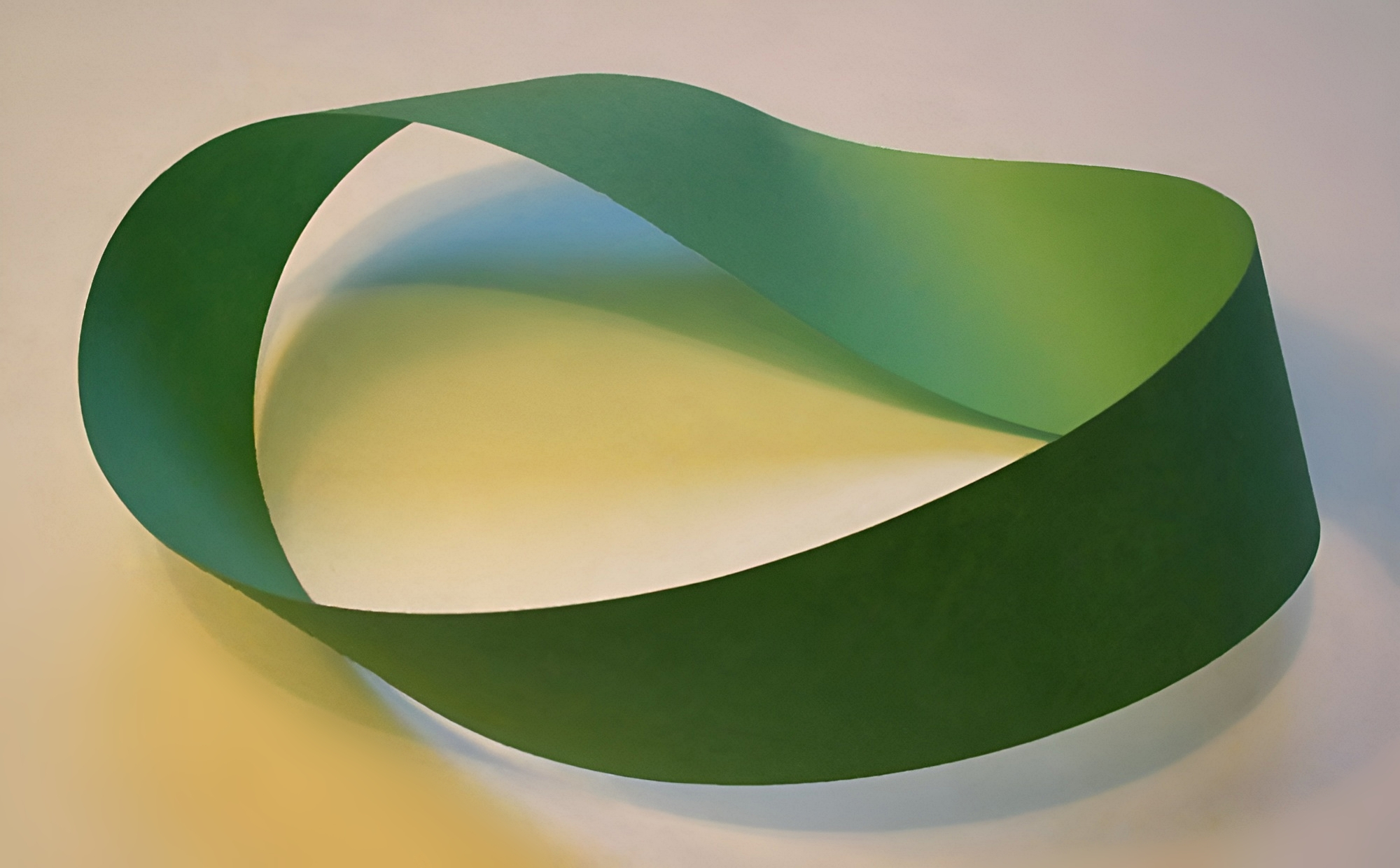
In particular, for our definition of orientable surface it becomes rather intuitive to show that the Möbius strip is not orientable. Since, if it was orientable, the initial arrow would agree with the final arrow on the following animation:
Final remarks
The general the notion of orientability is much different, and intimately connected to the notion of integrability. However, it is also interesting to point out that this definition of orientability can also be generalized to manifolds of codimension one.